
Merry Christmas, You're Fired.
How Boards handle CEO transitions, and why it always seems to happen during the Holidays.


The Holiday Shuffle: Why Leadership Changes Seem to Happen Over the Holidays
It’s that time of year—stockings are hung, offices are closed, and Boards are managing leadership transitions. Why does it feel like executive hiring and firing spikes during the holidays? After years in this field, I’m convinced it is a real pattern. Let’s explore the reasons behind this theory, what the data says, and how Boards can prepare for executive terminations in general.
The Reason Behind CEO Changes During the Holidays: Results Are In, and Calendars Are Free
First, why would anyone fire their CEO over Christmas? It’s just practical. Boards and candidates alike are less tied up with day-to-day operations, and there’s more time to talk to other Board members, get everyone aligned, and dig into tougher conversations before the new year begins. Boards have enough visibility into year-end results and planning at this time of year to understand how the strategy is going. At least, that’s what I’ve always thought.
The Data Reveals Some Truth to the Myth
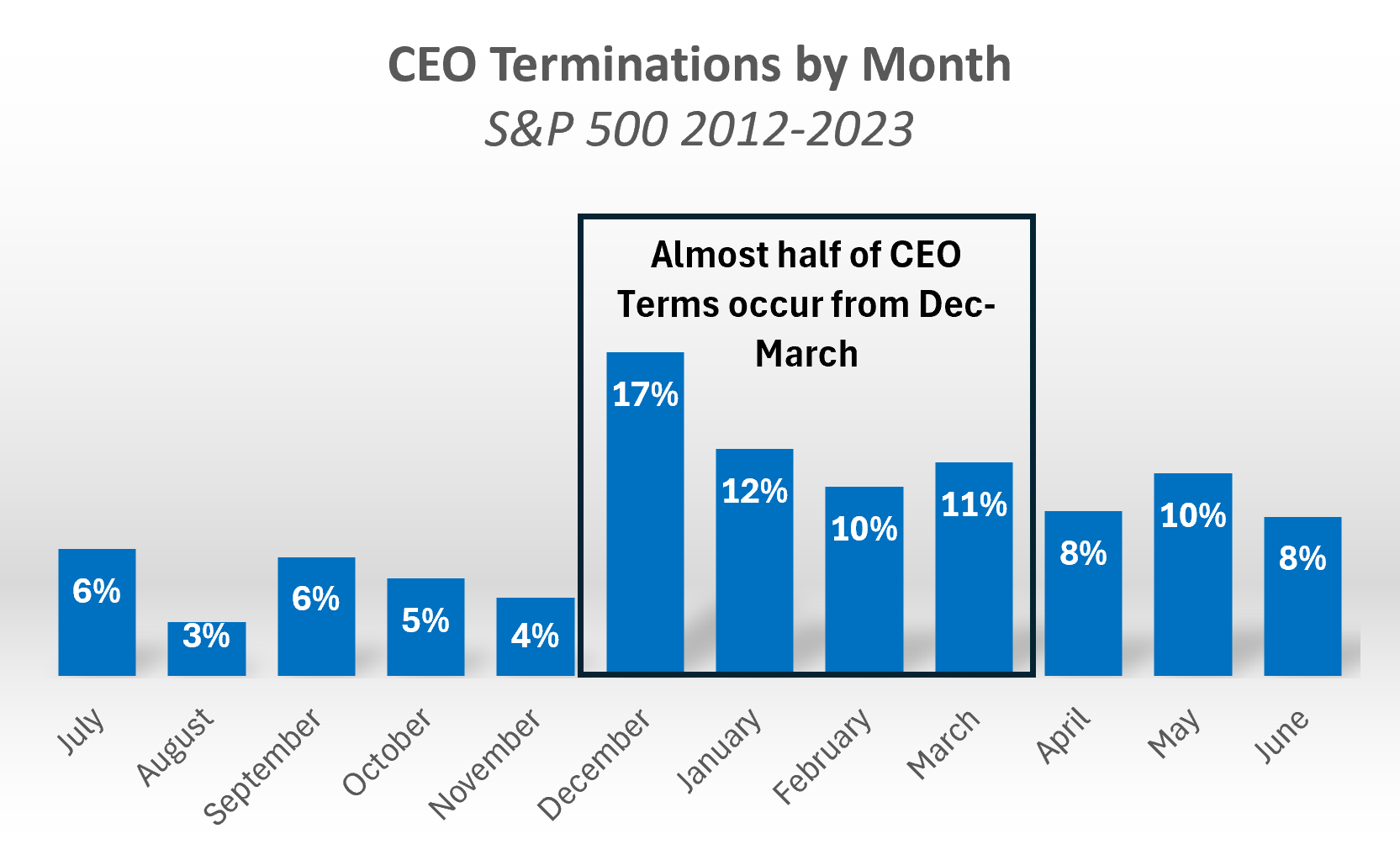
This data shows CEOs' formal “termination date” across the S&P 500 from 2012 through 2023 by month. There is a noticeable uptick in transitions between December and March, and ~50% of terminations occur in that four-month period. While some of these are planned retirements or leadership changes announced well in advance, others are abrupt. Many transitions effective from January through March are actually decided earlier, often in December, so I think the theory still holds. This suggests that year-end is a critical time for planning and decision-making, even if the formal handoff doesn’t occur until the new year.
Navigating the Nuances of CEO Transitions
So how do Boards handle these transitions in today’s governance environment? One challenge is balancing transparency with diplomacy. Proxy advisors like ISS and Glass Lewis push companies to clearly disclose when terminations occur, especially if severance is involved. For example, ISS is almost certain to recommend against a company’s Say on Pay if they provide severance without labeling the exit as a Termination Without Cause.
On the surface, this makes sense. Why should shareholders fund severance for someone who voluntarily retired? But the reality is that Boards and executives usually aim for a “graceful exit.” Often out of respect for long-standing executives, sure, but also to ensure executives sign releases with non-compete and non-disparagement clauses, which is critical in many scenarios. Publicly labeling a departure as a Termination Without Cause makes it harder to save face, get releases signed, and allow everyone to move on. Instead, and justifiably, Boards prefer to pretend someone departed on their own accord.
The ISS rules make this hard, and these days, Boards have started to go through hoops to navigate this. A new playbook has evolved, which includes:
- Keep the executive on the payroll in an advisory role through to the next fiscal year (when they fall out of the public proxy statements)
- Provide them with continued vesting on their equity arrangements
- Provide partial / negotiated compensation through the advisory period.
- Negotiate the arrangement by ensuring that the economic terms are greater than the severance they’d otherwise be entitled to and would be forfeiting.
Ironically, this playbook often results in severance packages that are more generous than they might have been otherwise through involuntary termination. This is a case where well-intentioned governance policies inadvertently make transitions more complex and costly. It is also difficult to negotiate this type of arrangement. It doesn’t always work, and sometimes Boards just land on paying out severance without calling it an involuntary termination and take heat from the proxy advisors.
Preparation Tips for Board and Executives
If your company anticipates a leadership change—or if you’re a CEO sensing the Board may be holding meetings without you this season—preparation is key (in general, but also to limit holiday scrambling). The list below contains important items to have on hand to navigate a CEO exit.
- Term sheet of termination provisions. Have a concise term sheet outlining key provisions related to termination scenarios.
- Severance Calculations: Prepare a detailed breakdown of severance benefits, including equity vesting entitlements, in the case of involuntary termination.
- Equity Value Assessment: Calculate the remaining value of all outstanding equity awards that the executive would forfeit through an involuntary termination. This is the ‘pool’ the Board can use to negotiate.
- If the compensation consultants and HR staff are really good, they’ll have a model that makes it easy to see equity vesting and forfeitures at different points in time under different termination scenarios. The precise timing of action sometimes becomes a major factor in negotiations.
By having these details ready, boards and executives can minimize the time spent crunching numbers and maximize their focus on negotiating a smooth and professional transition.
So, who’s on the holiday CEO shuffle list this year? Only time will tell. As Boards and executives navigate this tough topic, preparation and thoughtful negotiation remain key. I hope anyone involved in leadership transitions this holiday season can navigate with grace, professionalism, and fairness.
Happy Holidays!


