
Vibe-Coding & The New Talent Paradox
Predictions About AI, Talent Dynamics, and Compensation


AI-powered "vibe coding"—writing functional code through natural language prompts—is a big conversation nowadays. It's letting marketers build landing pages, analysts create dashboards, and entrepreneurs launch products without writing a single line of code. The barriers to building software are crumbling in ways we haven’t seen before. “The engineering priesthood is dead!"
Not so fast.
Here is the paradox: AI-generated code democratizes software development by lowering the barriers to entry, but it also raises the bar for the folks at the top. The best engineers can do more faster, making them even more valuable than before.
Claims that AI will merely lift the lowest performers or eliminate the engineering function are misunderstandings of what's happening. I think the skills we value in the workforce will change—some will be commoditized, but others will be dramatically elevated.
As a compensation consultant who works heavily in the technology space, I see this as a talent reset. We're about to see a reorganization of who creates value and what it's worth. Non-technical professionals will gain new autonomy. Elite engineers will become even more essential. Compensation models—long anchored to the primacy of the engineering function — will need to evolve to reflect a much more dynamic distribution of impact in different parts of the organization.
This shift creates a bigger premium on two key groups:
- Engineers who can architect, optimize, and debug at scale
- Non-engineers who can execute their vision and bring ideas to life
In this post, I share my early take on what could be coming with six predictions about how organizations and talent strategies will evolve — and why many companies will get it wrong. I'll also explore important cautions about the questions we’ll need to grapple with along the way.
Prediction 1: The 10X Engineer Becomes the 100X Engineer
As AI-generated code floods systems, elite engineers won't become obsolete (at least not yet); they'll become more valuable. Those legendary "10x engineers" (the geniuses who have an outsized impact) will now be able to accomplish 2x- 10x more than before, as they debug, optimize, and make production-ready code at scale in a world swimming with AI-generated solutions.
This idea is foundational: when exceptional engineers can leverage AI to multiply their impact, it reshapes entire organizations around them. The most mission-critical projects and thorniest problems will flow to these difference-makers, transforming organizational structures, labor markets, and strategic priorities. In technology, organizations largely exist as interconnected networks that support and amplify the impact of these key individuals—AI doesn't eliminate this dynamic, it intensifies it.
The investment thesis for paying engineers a lot of money has always been that tech development cycles are fast, and you must keep up to survive. Investing heavily in 10x engineers is an obvious strategic choice for many companies, especially those with market cap to support big talent bets through equity grants. As development cycles accelerate, the perceived gap between good and extraordinary engineers will only widen, reinforcing the economic premium placed on the truly rare and exceptional superstars.
Prediction 2: The Workflow Pipeline Inverts
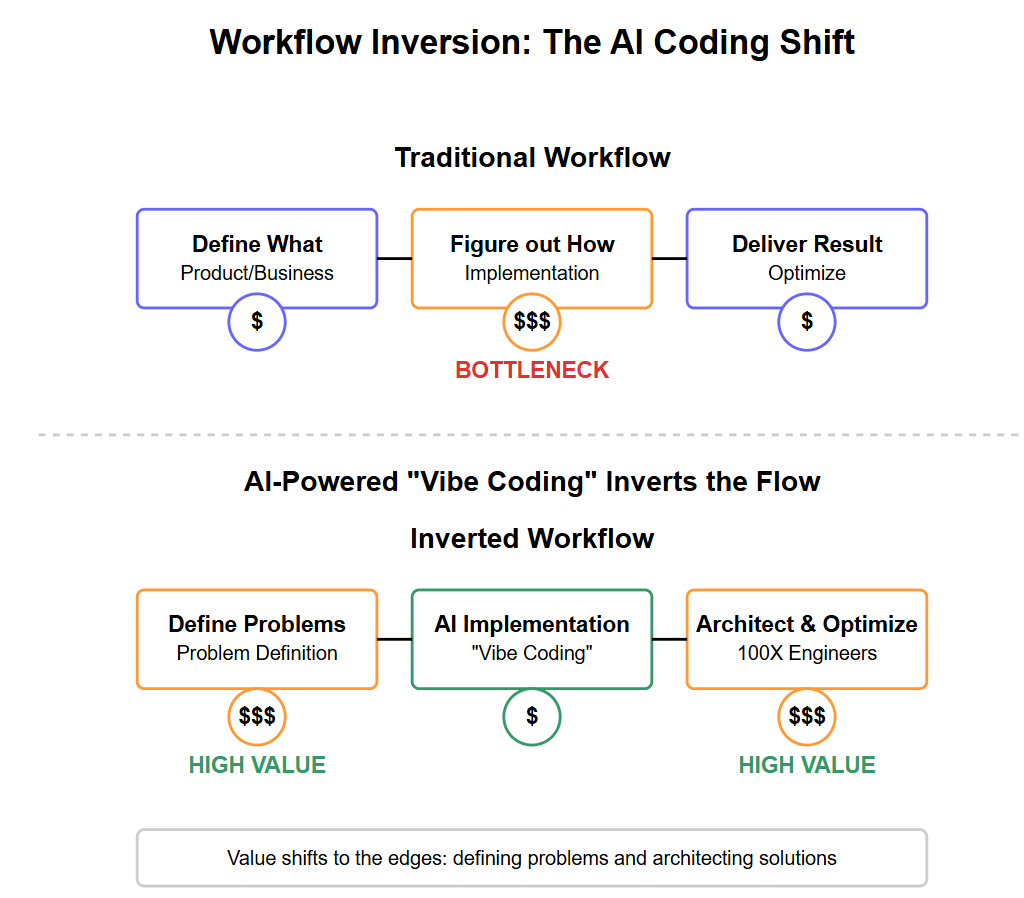
The classic workflow—define 'what,' figure out 'how,' deliver the 'result'—is about to flip. Implementation has always been the bottleneck, requiring specialized engineering skills. Vibe coding has the potential to break this bottleneck, shifting scarcity to the edges. Those who can define the right problems and ensure robust, scalable, and effective solutions will be the most valuable. The middle layer of implementation specialists could thin while visionaries and architects become more critical.
Prediction 3: Non-technical Functions Become Hotspots for Innovation.
As coding tools democratize, functions that were historically at the bottom of the engineering queue might finally get to self-serve. HR, Finance, and Operations teams can build scrappy solutions without waiting for scarce engineering resources. A marketing manager might test new tools without joining the dev queue. A finance analyst could create automation that once required an entire engineering sprint. Hidden deep within organizational layers, there may be gamechangers waiting to make an impact.
Prediction 4: A New Kind of 10x Talent Emerges
We might see the rise of the 10x non-engineers: the less technical people who can identify opportunities, design solutions, and implement them without technical dependencies. Just as companies recognize 10x engineers who deliver outsized impact, we may see 10x talent across all functions. On the losing side: the pure "ideas people" who can't execute enough to validate their ideas or rely on large teams will find their contributions diminished, and pure "executers" will struggle to build strategic solutions. The ability to execute independently could become a key differentiator across all functions. A skill that companies search for, hire for, and reward for impact.
Prediction 5: “Doing more with less” Becomes a Status Symbol
When money was cheap in technology, team size became a proxy for importance within an organization (for better or worse). In a vibe-coding world, this could flip, and organizational efficiency and autonomy could become the real status symbol. A small headcount might mean “everyone here has 10x impact”. Companies might get better at praising leaders who accomplish more with smaller teams rather than those who build large departments, and savvy companies will find clearer ways to evaluate operational innovation, scrappiness, and impact. I am hearing the tone/ tenor of this shift happening on the ground, comments like “how embarrassing they needed that many people to do XX”.
Prediction 6: A Corporate Exodus
Top engineering talent has already bypassed traditional corporate careers, with the brightest minds from elite schools founding startups or joining venture-backed teams. Non-technical professionals, however, had fewer options to sidestep these conventional paths. As AI democratizes development, anyone can now build without technical dependencies, making the slow corporate climb less compelling for all talent types. Large companies will increasingly compete not just with startups but with the very idea of entrepreneurship itself. These new offramps from corporate life will offer more than money: autonomy, flexibility, and creative freedom. Companies will have to figure out how to either compete with money or with all the other parts of an employee value proposition.
When Everyone Can Code, Who Gets Paid?
These predictions collectively point to a redistribution of value creation across organizations. Compensation models will change to follow suit. The question isn't just who can vibe-code, but whose coding (or prompt engineering) creates disproportionate value, and how organizations will recognize and reward that value.
Tech companies have always broken their compensation bands for star engineers. Now that pattern may intensify and expand beyond engineering teams. As AI democratizes coding:
- The best engineers become far more valuable…the 100x engineer.
- Non-technical innovators finally break through…the 10x talent.
Smart organizations will weaponize this shift. They will recognize that not all impacts are equal and will figure out how to manage that within their pay systems. But how? Spotting the real difference makers is extraordinarily difficult, and the companies that crack this puzzle, who attract and retain the real superstars, will be the leaders. For large companies with big market caps to fund outsized equity bets on many people, it will be easier to place big bets. Still, the leaner organizations without as many resources will need to get really good at figuring out who drives the impact and how to keep them around, whether through compensation or other means (culture, autonomy, impact, etc).
To be clear, 'breaking the compensation bands' is risky. A lot of companies that did it during the pandemic years did so poorly and ended up either spending too much or hollowing out their culture by focusing too much on pay. It can be easy to forget that most of the true difference makers —those 100x engineers—are often hunting for value creation opportunities more than just higher pay. Many companies are still nursing wounds from that unstructured talent free-for-all. And this time? Even tougher. Tomorrow's superstars won't wear neat functional labels. That HR genius might be the next product visionary, or the finance star might be more valuable by focusing on marketing analytics. Not only might superstars be paid more, but if you can spot them, they might be deployed in entirely new ways, too.
What is lost and what is gained?
The predictions I've outlined point to a reorganization of impact and talent value - one that offers possibilities alongside legitimate concerns. When the landscape shifts this dramatically, there will be winners and losers.
I assign no moral judgment to these emerging dynamics and am merely describing what I’m observing, but there are still important questions that require consideration:
- What happens when extraordinary impact concentrates in fewer hands? Does this worsen existing inequalities or create new opportunities for brilliant minds regardless of background?
- What happens to the vast middle? This is perhaps the most concerning question: What about those competent and professional mid-level engineers who form the backbone of many tech organizations? When AI handles routine tasks and elite engineers scale exponentially, does this middle tier face painful compression or find new ways to add value?
- What happens to all the other layers of non-technical managers and layers of coordination already in place where the collaboration and mentorship happen? What about training and development pipelines that depend on those layers to build tomorrow's workforce and coach future superstars?
- What's the new career pathway to becoming a 10x or 100x contributor? Will formal education matter less than self-taught skills, or will elite mentorship become even more critical for accessing opportunities, boxing out future stars without the right pedigree? How will organizations identify and nurture tomorrow's superstars?
- In flattened organizations, how do we preserve and transfer the domain expertise that often requires years to develop? What happens when institutional knowledge no longer has a clear home?"
- What blind spots will emerge with these new archetypes? Will empowered non-engineers sacrifice process safety for speed and flood systems with bad code? Might 100X engineers create systems too complex for anyone else to maintain? What soft skills will be left to the wayside in pursuit of impact?
- Are we merely trading one priesthood (engineers) for another (AI platform owners)? What happens when these platforms become landlords, extracting increasingly expensive rents for access to capabilities that everyone now depends on?
- Will the divide between those with access to technology and those without widen? Be it through access to AI software that requires a monthly subscription or just bad internet access? How do we make sure the infrastructure that creates this opportunity is accessible and equitable?
Even with the unknowns and the scary pieces of new technology, there is a lot of optimism to be had. Democratizing opportunity can be an excellent thing for everyone. When a brilliant kid from a small town without formal engineering training can build products independently, that is good. When a do-gooder can create something for their community without a full engineering team, that is good. When parents of young children can build something in their free time, dreaming of an exit from the corporate grind, that is good. There is opportunity everywhere, and it’s suddenly available to a far broader audience.
This transition won’t hit industries equally and all at once. Like many things, we’ll probably see changes flow out of the start-up world, into software, and then hit regulated industries like healthcare, finance, and government a little later as they operate within regulatory constraints.
Companies, my clients, will need to contend with a new reality: it's becoming easier and potentially more appealing to opt out of the corporate ladder entirely. You don't need funding or a team anymore. You just need time, ideas, and an AI assistant. THAT is what companies will be competing against, not just each other. To win, they will jump over each other to create space for top talent to thrive and appropriately compensate them for their outsized value. The investment cycles are too fast, and the risk of falling behind is too high, so investing in superstars is still mission-critical for many companies.
The conclusion remains: the talent playbook is changing. It’s been changing in technology for a while now, but now it’s changing faster, and in more places, and the stakes of that change are higher than ever for organizations looking to lead in tomorrow’s economy.
Thanks for reading! This post is public so feel free to share it.


